Thursday, 15 October 2009

Sub-Genre - Sci-Fi Thrillers

Sub-Genre
Sci-Fi Thrillers

Most thrillers have the combination of most other genres including horror, conspiracy, and psychological tricks used to increase tension. Combinations are very diverse, including Sci-Fi Thrillers (Science Fiction Thrillers)

In Sci-Fi Thrillers it's usually set in the future, or in a historical past that denies facts of known information of history. Also they can have settings from outer space involving Aliens. Sci-Fi Thrillers will include stories that involve technology or scientific rules (e.g. time travel), discovery, new technology (e.g. Robots) or of new and different political or social systems.

An example of a Sci-Fi Thriller is Alien (1979)


When you watch the trailer immediately you know its a Sci-Fi Thriller as it captures the audiences attention from the start and has a setting with spaceships and aliens. There includes quickly moving shots, which makes the audience watch carefully (engaging), flashing lights and dark colours (Black and Green), These also put the audience on the edge and lets them know its going to be a scary film. Also by the way it splits up its shots going into the short sentences (where there's information about the film and persuading lyrics), they use bold white writing with a bold green outline surrounded by a black background, this makes the font stand out. The black can signify the darkness/space, the green can signify the aliens.

Alien is a perfect example of a Sci-Fi Thriller because of all the generic conventions it includes. It is very similar to the Thriller genre because of the way it creates suspense and tension! Shots used within the trailer are close up shots, where you can see the details of the characters expressions, and it shows the important objects used at the time (e.g. The spaceship). They also use long shot where you can see the setting of where they are.

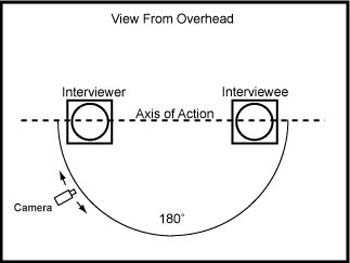
180 Rule

180 Degree Rule

In professional filming the 180 Degree Rule applies while filming (with a digital video camera) two characters (for example having a conversation) where there is an imaginary axis. The camera stays within 180 degrees on one side of the axis. If the camera goes around to the other side of the axis the characters right/left will change (which can be quite confusing) it is called crossing the line. The shot from the opposite side, is called a reverse angle.

The characters should always have the same right and left, which is why we stay 180 degrees within the axis. The 180 Degree Rule is often used in conversations where Shot Reverse Shot is required and it is an important element required for a style of film editing called continuity editing. This way in dialogue you can always identify who is speaking or responding using their facial expressions.

Wednesday, 14 October 2009

Prelim Task - The Text

This is the video of our prelim task, where we exercised particular techniques such as, close up, over the shoulder shots & shot return shot, this is in preparation for our Thriller opening.
I have learnt a lot from this task and I am pleased with our outcome because I think some of our shots were good, for example the close up of the text. We had the chance to get used to using the camera and practicing different shots. I learnt that you can do/add so much more effects to the films using Final Cut Pro.

I think I performed well within the task because I contributed to ideas, worked as a team and worked hard within my role. Although I'm not an actress, I tried my best when it came to it, to make the film interesting and believable. We also had a fair share of editing our film.

Next time I would make sure we use the tripod much more, to steady out shots to make it look more professional. It now makes me look forward to filming our Thriller openings and doing research on Thrillers to get a good idea of interesting Thriller opening.

I before I started AS Media I had experience of using a camera (e.g. filming events/myself singing). I had never used the camera we used for our task, so it was a good experience getting used to a HD camera. I have had little experience editing such as using Windows Movie Maker. I now have experience in using Final Cut Pro (editing/cutting/putting together short films) and I now have the skills for using a professional camera and filming.

In addition to my up and coming Thriller film, very good camera shot will be needed and good acting will be needed because this with capture the audience in the right way. My Thriller will have to included the appropriate music to engage the audience and help bring tension to the story.


The Text - Shanice, Ellen & Matt

Wednesday, 7 October 2009

Independant Research - Thriller Directors - Alred Hitchcock

Alfred Hitchcock (13 August 1899 – 29 April 1980)

Alfred, also known as 'The Master of Suspense' was a successful British filmmaker/director and producer in creating suspense in Thriller genres. He was one of the most popular and most recognised filmmakers, his works are still popular today.
At a very young age he regularly visited the cinemas and read many journals and his interest grew from there. He once said that "Even my failures make money and become classics a year after I make them.". Hitchcock made films that would engage the audience a capture their emotions straight away. Throughout his filming career his filming was diverse and crossed many genres such as, Thrillers, Romantic, Comedy and Drama.

Famous films Hitchcock has made are films such as

The Birds (1963)
Starring: Rod Taylor and Tippi Hedren
Terror strikes out of nowhere when birds begin mysteriously attacking anyone and anything in their way.

Psycho (1960)
Starring: Anthony Perkins and Janet Leigh
The seminal horror film of a young man tormented by his past-- and his mother.

Suspicion (1941)
Starring: Cary Grant and Joan Fontaine
Lots of suspense and fine-drawn tension in this mystery of a wealthy woman who suspects her playboy husband wants to murder her.

Other films he has produced/directed are, Jamaica Inn, Mr & Mrs Smith & many more!

Editing Our Prelim Task - 'The Text'

Today we was in the editing suite, editing our prelim task films. This was my first time using Final Cut Pro. I got the basic knowledge of how to import and edit videos. It can be straight forward once you know what your doing.
When editing the film we found that we didn't film the 'Shot, Reverse, Shot' technique properly because we missed out the last shot (our shot reverse shot wasn't clear). Also we had to make certain shots longer than how they were filmed (to make it clear of what was being shown). We managed to use effects in Final Cut Pro, such as a Fade Out. We used this at the beginning and end of our film, which makes it look more professional. We added a title at the start of the film, where the name our our film would appear.
By the end of the lesson my group (Ellen, Matt & Myself) had completed the task set. We added/made a soundtrack to the short film (which we enjoyed doing because we could experiment with all the sound effects we had and add them into the film)!

I enjoyed this task overall because i now have a basic understanding of how to edit a video in Final Cut Pro! It also make me look forward to doing more filming and editing.

Saturday, 3 October 2009

Memento - Opening Sequence

Film: Memento (2002)
Starring Actor: Guy Pearce
Director: Christopher Nolan

I studied the opening sequence of 'Memento' and from the titles i knew it would be a thriller film. As the titles appeared, there was a close up of pictures from a brutal murder scene (which gave it away that it was a thriller) and as time went by the picture disappeared and became less clear. As the titles were shown non-diegetic music is played using various dynamics.

The opening is also in reverse of the what happened (the outcome/ending). Then the story goes to the beginning, which will then lead on to solving the mystery of why he murdered.

Shots used within the opening are close up shots, where you can see the details of the characters expressions, and it shows the important objects used at the time. It also shows you that the character is important in the story. Other shots used are over the shoulder shots. This is used when he shoots the victim. This shows that he has power and authority, he intimidates the victim. But when theres close up shots of the main character it shows that hes quite venerable
As well as the still shots, tracking is used when both characters are walking and talking in a conversation.

The generic theme is that a murder has taken place and the main story line has started from the end instead of the beginning.
The film is very realistic and believable, for example the murder scene at the start where threes a gun, blood and bullets on the floor. It suprises the audience that the opening is a murder scene and make them want to see more to find out the full story.

Thursday, 1 October 2009

Prelim Task - 'The Text'

For our Prelim Task, in groups we had to film someone walking though a door & be in a conversation. techniques we were required to use were
Action Match shot
for example when someone walks through the door, the camera zooms up on the handle. then in a new shot the camera is on the other side of the door.
Shot Reverse Shot
This technique is used in conversations
180 Rule
This technique is used for activities e.g football. Its important that you get your angles right.

In my Group there was Matt, Ellen and myself. We made a prelim called 'The Text'. While sitting down as a group, planning our story line and camera techniques we would use, We made notes of what of what we would do. Firstly we decided that Matt would film/direct the film and Ellen and myself would act.

The script of our Prelim Task:
1. close up of the phone (Text)
2. Put the phone away into pocket (Close up)
3. Open the door (Close up, on handle)
4. Open the door, Walk down corridor (focusing on the feet)
5. Medium Close up from a low angle of Ellen on the stairs
6. In the distance, Shanice walk down the stairs next to eLLEN
7. Over the shoulder shot. Shanice says "Are you alright"
8. Over the shoulder shot. Ellen Says "She did it, she actually did it"
9. Behind/Mid Shot. Shanice puts her arm around Ellen
10. Medium close up shot, zooming out into a Long shot with Shanice and Ellen walking away in to the distance (Fade out).

After planning we got filming!
The filming went well and as planned because we worked as a team and followed our script. The type of shots we used were: Tracking, Over the Shoulder, Low Angle & Mid Shot.
The filming went as planned although we made minor changes with our shots. For example when Ellen sits on the stairs, it was meant to be a close up shot but instead it was a Medium shot. Also we found it hard to do some of the over the shoulder shots (in Shot Reverse Shot) because on the stair case there was not a lot of room to go behind the person. A technical difficulty we came across was that we lost some of our work at times and had to re-record it.

I enjoyed this task because once again we had the chance to use the cameras, and it makes me look forward future tasks. Within the group we got along well and made positive contributions to ideas. I got used to the idea that it isn't so much about the story line but the techniques and use of the camera was important.